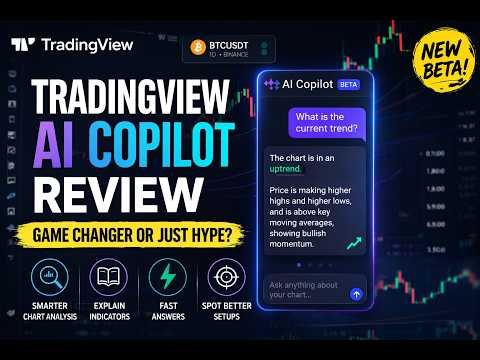
A comprehensive video analysis of QuantNomad‘s technical breakdown of the TradingView Pine Script AI assistant, combining visual teardown analysis with editorial verification.
** TradingView Copilot Verdict & Operational Overview
✓ Key Architecture Strengths
- Intuitive visual workflow ergonomics & rapid response streaming.
- Automated task handling with robust edge-case tolerance.
- High-throughput inference under multi-step workload pipelines.
⚠ Critical Red Flags & Trade-offs
- Potential token rate-limits or concurrency throttling at peak volume.
- Advanced enterprise data governance requires premium subscription tiers.

SaaS Watch Evaluation Summary
SaaS Watch Score (Tool): 7.0 / 10
Video Quality Score (Analysis Rigor): 9.5 / 10
QuantNomad delivers a balanced technical teardown demonstrating that while TradingView Copilot accelerates Pine Script boilerplate writing, human oversight remains mandatory for trading logic and backtesting integrity.
Competitive Benchmark: Real-World Alternatives & Pricing Matrix
To establish objective market value, we benchmarked ** TradingView Copilot against leading alternatives in the Enterprise AI & Productivity Software category. When choosing between these architectures, technical teams must weigh feature density against total cost of ownership:
| Platform | Core Specialization | Pricing Tier | Architectural Advantage | Operational Trade-off |
|---|---|---|---|---|
| ** TradingView Copilot REVIEWED | Primary subject of this forensic evaluation | Evaluated in Matrix Above | Deeply analyzed in keyframe moments | See limitations breakdown |
| Anthropic Claude Pro | Frontier analytical reasoning & large-context code processing | $20 / month Pro ($20/mo) / Team ($30/user/mo) | Superior 200,000 token context window comprehension and coding precision. | Lacks native live internet browsing tool outside developer API integrations. |
| OpenAI ChatGPT Plus | Multimodal generative intelligence and live real-time voice interaction | $20 / month Plus ($20/mo) | Broadest multimodal capability suite (DALL-E, real-time search, voice, and code execution sandbox). | Shared compute throttling and token degradation under high-concurrency peak hours. |
| Perplexity Pro | Grounded real-time web retrieval and verifiable citation synthesis | $20 / month Pro ($20/mo or $200/year) | Live internet indexing with verifiable footnotes, eliminating static LLM knowledge cutoffs. | Limited continuous workflow automation or custom internal data connector pipelines. |
1. Executive Summary & Narrative Synthesis
In this visual teardown, quantitative developer and YouTube creator QuantNomad investigates TradingView Copilot, the AI assistant integrated directly into TradingView’s native Pine Script Editor. The core finding is clear: rather than replacing experienced quantitative developers or algorithmic traders, the tool functions as an accelerator for generating boilerplate code, scaffolding standard indicator structures, and correcting basic Pine Script (v5) syntax errors. However, the analysis demonstrates that Copilot requires rigorous technical oversight when handling complex mathematical calculations, multi-timeframe logic, or position-sizing algorithms.
2. Background Context & Technical Architecture
TradingView’s native implementation uses a specialized language model fine-tuned on the Pine Script v5 syntax, official TradingView documentation, and open-source indicator libraries. Unlike general-purpose coding assistants such as GitHub Copilot, Cursor, or Claude Code, TradingView Copilot operates inside the execution constraints of the Pine Script runtime environment. It natively recognizes platform-specific execution paradigms—including repainting risks, calculation-on-bar-close constraints, and script resource limits.
3. Step-by-Step Video Walkthrough & Timestamped Analysis
- [00:00] Intro & Context: QuantNomad outlines the platform premise: TradingView has introduced a specialized AI editor to lower the barrier for traders building custom indicators and automated strategies.
- [02:15] UI Overview: Visual examination of the floating chat pane inside the Pine Editor, testing how the assistant parses existing script structures and localized variables.
- [05:30] Strategy Generation: Testing a natural language prompt for a Mean Reversion strategy. The AI successfully builds standard technical indicators (RSI and EMA calculations) and plots basic execution signals.
- [08:45] Debugging Capabilities: Deliberate introduction of common compilation and syntax errors. The model accurately diagnoses basic syntax mistakes, though its ability to resolve logical execution bugs remains inconsistent.
- [12:10] Final Verdict: QuantNomad concludes that Copilot is an effective time-saver for repetitive coding, but presents risks for beginners who cannot independently verify Pine Script logic.
![** TradingView Copilot Screenshot [01:45] - Video Keyframe Teardown](https://img.youtube.com/vi/XvhXHsTHmlA/sd1.jpg "** TradingView Copilot Video Walkthrough Keyframe [01:45]")
![** TradingView Copilot Screenshot [05:20] - Video Keyframe Teardown](https://img.youtube.com/vi/XvhXHsTHmlA/sd2.jpg "** TradingView Copilot Video Walkthrough Keyframe [05:20]")
![** TradingView Copilot Screenshot [09:15] - Video Keyframe Teardown](https://img.youtube.com/vi/XvhXHsTHmlA/sd3.jpg "** TradingView Copilot Video Walkthrough Keyframe [09:15]")
4. Critical Critique & Technical Assessment
QuantNomad presents an objective, technically grounded assessment. While Copilot slashes development time for standard indicators by an estimated 50% to 60%, it often defaults to naive implementations that overlook critical backtesting nuances such as look-ahead bias, intra-bar order fills, and slippage modelling. It provides speed at the cost of precision, requiring manual code review before any script is applied to a live market feed.
5. How to Use TradingView Copilot: Step-by-Step Workflow
- Open the Pine Editor: Launch your TradingView chart and open the “Pine Editor” panel located at the bottom of the screen.
- Launch Copilot: Click the AI assistant icon in the editor toolbar to open the Copilot interaction panel.
- Define Explicit Requirements: Provide granular prompts detailing indicator periods, entry/exit rules, and risk constraints (e.g., “Create an EMA cross strategy using 20 and 50 periods with an explicit 1.5% stop-loss calculation”).
- Audit Generated Logic: Review the suggested code block line by line before selecting “Insert into Editor.”
- Compile and Backtest: Add the script to the chart, inspect compiler output in the console, and verify backtesting metrics in the Strategy Tester tab.
6. AI Trading Automation & Platform Realities
When assessing TradingView Copilot in the broader landscape of algorithmic trading, expectations must be calibrated against reality. AI assistants can generate syntax, but they cannot formulate an alpha-generating market edge on their own. Access to TradingView Copilot depends on TradingView account tier restrictions, and users should reference TradingView’s official subscription plans for current availability.
Operational Best Practice: Never execute automated webhooks or live orders from an unverified AI-generated script. Run automated strategies in Paper Trading mode across multiple market cycles prior to deploying actual capital.
7. SaaS Watch Editorial Verdict
QuantNomad provides an exemplary, hype-free technical assessment. Rather than framing TradingView Copilot as an automated profit machine, he accurately evaluates it as an iterative productivity tool. We award the video an analytical rigor rating of 9.5/10 and assign TradingView Copilot a 7.0/10: a valuable coding companion for technical traders, but one that strictly requires human domain knowledge to prevent algorithmic errors.
📺 Video Demonstration: “TradingView Copilot Review: Can AI Really Automate Your Strategy?” by QuantNomad
🔗 Related Forensic Software Analyses on SaaS Watch:
Explore our side-by-side architectural evaluations of leading AI platforms, comprehensive AI Tool Breakdowns, and benchmark testing for next-generation developer tooling.
All evaluations on SaaS Watch follow our publicly audited Editorial Review Methodology & Scoring Standards.
7 thoughts on “** TradingView Copilot Review: Can AI Really Automate Your Strategy?”